
7 Trends in edTech Product Design You Should Know for 2026

From the rise of AI product integrations to alarming upticks in chronic student absences, 2025 gave us transformative new technologies to work with—and new challenges in education to navigate.
At the heart of it all, educators face mounting pressure from their schools and districts to adapt to new expectations about learning technology.
Almost half of teachers in the U.S. have learned how to use AI-powered learning tools in the classroom, often without institutional training and support.
And they’re doing it all while managing increased demands on their time from mounting administrative tasks.
edTech product leaders will have to adapt along with them, creating products that streamline educator workloads, safely incorporate AI, and support both educator and student wellbeing.
Whether you’re planning ahead for Q1 or re-thinking your Fall 2026 launch strategy, here are the seven trends, strategies, and solutions we think will drive edTech product design next year.
Which trends do you feel ready for?
1. Fine-tuning your product’s approach to AI adoption
If there’s still apprehension at your organization about using AI strategically in your edTech product, know the market isn’t against AI as a whole.
Whether you’re developing AI tools to support educators with their planning and instruction needs or to improve student learning outcomes, product owners will be well-positioned to continue leading internal conversations about AI product integration throughout 2026.
The following use case categories from Education International can help you navigate internal discussions with your product team:
- Institution-focused AI products streamline administrative operations like scheduling, identifying safety concerns, and supporting at-risk students.
- Teacher-focused AI products support teachers with assessment, lesson planning, and curating resources.
- Student-focused AI products provide adaptive tutoring content and writing evaluation systems.
At Backpack, we’re especially interested in teacher-focused AI products and how teachers use generative AI tools.
According to Carnegie Learning, nearly half of teachers use generative AI tools in the classroom to support their planning and instruction needs, including applications ChatGPT and MagicSchool.
Educators are hungry for additional professional development in AI workflows, which makes product-centered professional development content and onboarding flows a smart investment.
Take inspiration from the AI certificate courses offered by AI safety and research company Anthropic, the creator behind Claude.
You can also consider how to help your users learn to make the most of the AI-powered workflows in your learning tools at point-of-need.
2. Creating complex learning content at scale
As more educators adopt learning tools powered by generative AI, we anticipate interesting market opportunities for organizations that help educators create complex learning content at scale.
Consider a time-intensive teaching approach like project-based learning, for example.
Prized for its approach to helping students direct their own learning experiences and collaborate with peers, project-based learning takes additional time, effort, and experience for educators to facilitate.
edTech products that help educators quickly build new resources and content pathways for time-intensive teaching approaches can ease common pain points around content creation and classroom management.
If your learning tool has a lot of content already, consider how you might give students more opportunities to choose their own topics or collaborate with peers to promote independence and process skill development.
The tools for helping educators create and adapt learning content are in place. Smart product owners will find ways to help teachers create quality learning content at scale.
3. Managing buyer expectations around student privacy
Generative AI technology is exciting, but it also brings new security threats, ethical challenges, and needs for verification and oversight.
Remember: schools now manage increasing amounts of sensitive student data.
Because of this, they are also more focused on the ethics, privacy policies, and security practices of their edTech vendors, especially when AI is integrated into learning tools.
Product owners can prepare for increased scrutiny and shifting security needs by talking to their development teams about data management early and often.
Here’s what to prioritize as you navigate these discussions internally:
- Data collection. Know what data you’re collecting, why you need it, and where it lives. This is especially true if you’re using AI tools. If the feature feels unnecessary, cut it.
- Roadmapping privacy practices. Build time into your product roadmap to discuss, plan for, and test security and privacy practices.Better yet: treat privacy testing and policy updates like the rest of your product feature work. These sensitive practices need time and resourcing, too.
- Stress tests. Run occasional “what if” stress-tests. What if an integration breaks? What if an AI model behaves weirdly? These simple exercises build resilience internally and trust externally.
- Internal alignment and external messaging. Make sure product, development, sales, and marketing teams understand your privacy practices.That way, everyone can tell the same story externally, and your brand communications are consistent in every place customers interact with your tool.
In 2026, communicating robust data security practices and clear ethical standards will be a differentiator—especially when it’s backed up in your learning tool.
The more your team can support safe data practices internally, the easier it will be to build trust with your buyers and safeguard the teachers and learners who use your tools.
4. Creating professional development content that supports educator wellbeing
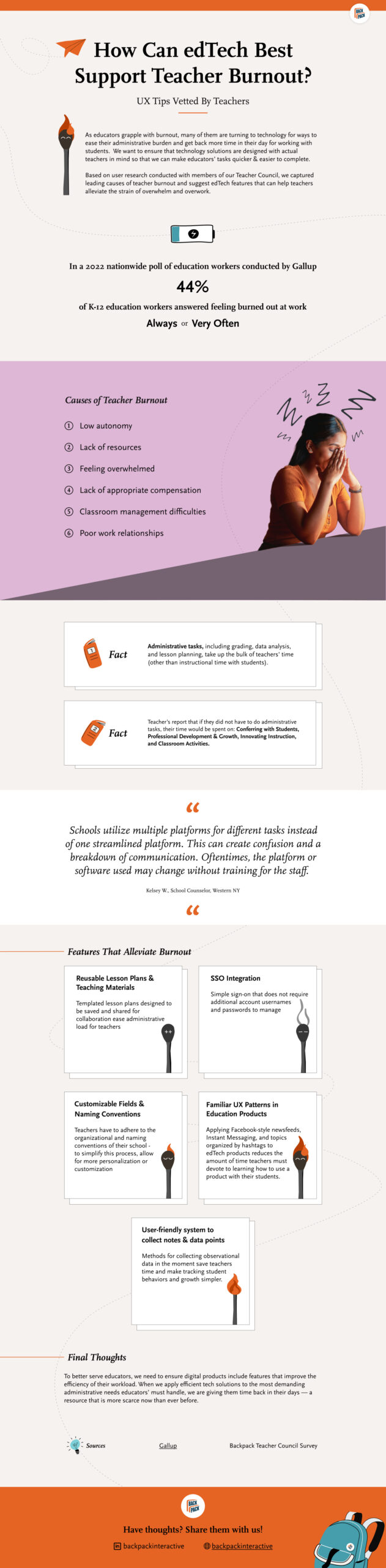
Teacher wellbeing reached a critical juncture in 2025. Educators reported record levels of burnout due to rising workloads, staff shortages, and student behavioral challenges.
EdTech solutions that reduce teachers’ administrative burdens, support their mental health, and help educators improve their resilience will help to counter the effects of burnout and job dissatisfaction.
Consider how your tool might include professional development content and training that validates teacher needs.
This might look like:
- Personalized learning content recommendations
- Sorting available training content by years of experience or classroom need
- Providing educators with out-of-the-box classroom management strategies they can use immediately
Newsela’s professional learning platform is a comprehensive example of this strategic approach.
With customized professional learning pathways, product integration, and resources embedded at point-of-need, Newsela offers a flexible approach to supporting changing needs for educators.
5. Supporting student wellbeing and early intervention in mental health challenges
Integrated data systems have transformed how schools address student mental health.
For example, platforms like Nearpod and Raptor’s StudentSafe provide real-time views of student well-being by consolidating information from screenings, counselor reports, attendance records, and academic performance.
Using data, these platforms help educators identify students who may need additional support and design interventions.
As more schools adopt these tools for liability and prevention reasons, we expect the importance of data visualization in edTech products will only grow.
Actionable data dashboards and reporting tools are critical needs for edTech buyers, and will result in more buy-in at the district and school level.
At the product level, this might look like:
- Helping teachers track and inventory student behavior
- Showing connections between behavior and academic performance
- Providing at-a-glance reporting and intervention guidance
- Streamlining communication between schools, families, and counselors
Whatever your product strategy, helping schools make sense of student behavioral data in more holistic ways will become ever more valuable in 2026 and beyond.

6. Product planning for the digital divide
Disparities in school internet access, device availability, and digital literacy only deepened last year, and we expect these challenges to continue to affect edTech product design in 2026.
Thankfully, product teams can plan flexible approaches to design in order to counter uneven access to WiFi or limited access to technology.
Throughout the product planning process, we recommend:
- Researching and testing your ideal customer’s access to technology. What technology restrictions exist at school? At home?
- Communicating with design and development about device usage and design needs
- Prioritizing responsive design as much as possible and as budgets allow
We understand that budget constraints may prevent responsive design approaches. If budgets are tight, consider how you can prioritize mobile-first design approaches instead.
Mobile-first design isn’t always considered throughout the edTech design process because young students are less likely to have access to mobile technology in a classroom.
They will, however, likely have access to mobile technology at home, which makes mobile-first design a worthy alternative to responsive design.
User experience research will help you identify these environmental and infrastructural constraints, so your team can improve student access to digital learning—and make the most of your product budget.

7. Introducing career readiness content to younger students
The world students will enter after graduation now looks nothing like the one many of us prepared for.
That’s likely why we’re seeing middle schools embrace career and technical education not just as an alternative learning track, but as an essential part of the curriculum.
If you want to expand your existing learning content, develop a new product, or create a new supplemental learning tool, career readiness pathways for younger students will likely prove a solid investment opportunity.
Think about specific skills students will need, rather than broad approaches—and consider how the content you provide might serve as a bridge to high school learning content.
For example, your product might help younger students:
- Identify potential career interests and related high school course choices
- Understand alternative learning and career pathways, like technical or vocational school, entering the trades, or becoming a small business owner
- Develop specific real-world skills, from financial literacy to time management
While it’s hard to predict how career pathways will change in the next five to ten years, product owners can still play an important role in helping young students identify their interests, strengthen their process skills, and find the right educational opportunities for their goals.
Final Thoughts
Whether you’re working to improve data privacy in your learning tools or taking advantage of opportunities in the market, next year will define how edTech companies build trust with their customers and continue to grow.
At Backpack, we know you care about how industry trends will impact your product as much as they illuminate the user challenges that never truly go away.
That’s why we collect user experience research to help you validate your next move and develop product strategies that position your learning tool for success in a rapidly changing market.
Contact us below to find out how we can help your team get more clarity about your existing edTech product—or develop a roadmap for the next one!

Monica Sherwood
Prior to entering the UX field, Monica was a special educator at public schools in Brooklyn and Manhattan. Her experience as a teacher has allowed her to develop a deep appreciation for research, and the ability to empathize with the unique needs of every user. She is also a strong advocate for inclusion and accessibility in design.
Monica obtained her undergraduate degree at NYU’s School of Individualized Study, and her Masters in Special Education at Hunter College. In her free time, she enjoys traveling, painting, and reading.